
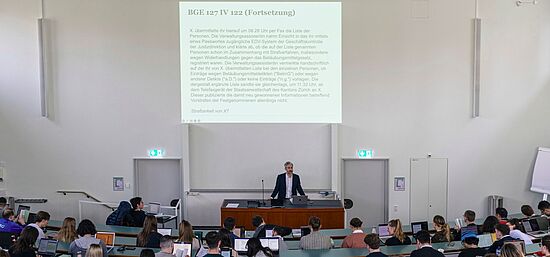
First stepsDigital skills for teaching staff
Universität Basel, Raisa Durandi
The digital transformation is reshaping higher education as a whole, including teaching. As indicated in the Strategy Digitalization in Teaching, the University of Basel sees the promotion of digital skills and literacies as an integral part of its role as a modern institution of higher learning. It is committed to equipping its members with the knowledge and skills they need to live, learn, and work in an increasingly digital society.
A the University of Basel, many resources are available that teachers can use to expand their digital competencies and to support students in developing their own skills.
Learning more about digital literacies
The Framework Digital Literacies, based on the JISC model for digital capability in academic contexts, serves as a guide for digital literacies at the University of Basel. It provides a comprehensive perspective on digital education, integrating not only technical skills but also more general themes such as security, data protection, inclusion, health and sustainability.
What role do digital skills play at universities? How can the Framework Digital Literacies be used in teaching? Which digital skills should students develop? Answers to these and further questions can be found in this self-learning resource on digital skills development in university teaching (ADAM-login required).
![[Translate to English:] p](https://digitalskills.unibas.ch/fileadmin/_processed_/1/7/csm_literacy-framework-icon_649ffcd4a7.png)
Developing your digital teaching skills
From direct personal exchange over workshops and courses to full certificate programs, the University of Basel offers a wide range of continuing education opportunities to strengthen digital competencies in general and digital teaching skills specifically.
The Educational Development team plays a central role in this area. It supports the modernization and further development of teaching, defines quality criteria for teaching and assessment, and offers certificate programs. More information about these offerings can be found on the team’s website.
![[Translate to English:] p](https://digitalskills.unibas.ch/fileadmin/_processed_/9/e/csm_digital-teaching-icon_496a525d01.png)
Conducting digital exams on campus
Would you like to conduct a written exam in digital form on the university campus? The service eAssessment on campus offers support in this area. Detailed information can be found on this website.
![[Translate to English:] p](https://digitalskills.unibas.ch/fileadmin/_processed_/8/7/csm_eassessment-icon_4a0e619d2b.png)
Discovering the university's tools for teaching
Be it the ADAM learning platform to distribute teaching materials and interact digitally with students, Zoom for synchronous exchange in teaching, Panopto for creating and providing videos, or Consensus for literature research – the University of Basel offers a wide range of tools for digital teaching.
On the EduTools page, you will find information regarding tools for teaching that are licensed and supported by the University of Basel. Additional useful information is available in the service catalog of the IT Services.
Teachers are free to select and use additional digital tools. The resource Getting started with alternative tools provides further recommendations, particularly for open-source programs that students and lecturers can use. Please note that the university does not offer support for these additional tools.
![[Translate to English:] p](https://digitalskills.unibas.ch/fileadmin/_processed_/a/e/csm_tools-icon_2d73be6d89.png)
Using AI in teaching
The meaningful integration of AI-based tools in learning and teaching is currently a central topic in higher education. To take advantage of this technology, AI literacy and a reflective approach to the AI transformation are important prerequisites. The web page AI in learning and teaching provides information on how the University of Basel is accompanying the AI-driven transformation in teaching. This Intranet page on AI in teaching offers additional materials and recommendations.
The continuing education program also includes numerous AI course and training opportunities for teaching staff.
![[Translate to English:] p](https://digitalskills.unibas.ch/fileadmin/_processed_/1/6/csm_ai-tools-icon_e6421da22d.png)
Promoting the AI skills of students
Whether it’s data protection, transparency, or proper citation: the principles of academic integrity (PDF) remain unchanged in the AI era. Teachers should provide students with instructions on how to work with AI in a scientifically correct manner.
These University’s guidelines on Citing AI tools (PDF) contains recommendations on how students may document their use of AI in their essays. Teachers and instructors can adapt these recommendations to their needs and disciplinary practice. For written work at all levels of study (Bachelor’s, Master’s, PhD), departments can use and adapt this Declaration of independent authorship (PDF).
Additionally, teachers can recommend the self-study course UPGRADE your digital skills to their students, which entails a module on AI use for learning.
![[Translate to English:] p](https://digitalskills.unibas.ch/fileadmin/_processed_/9/3/csm_supporting-ai-icon_67a60df1a8.png)
Designing and sharing documents and multimedia resources
The digital transformation makes it possible for individuals to complete many tasks faster and more flexibly on their own, including creating and sharing of all types of documents, from presentations and posters to academic articles and books. To ensure quality, it is advisable to observe certain standards.
The University offers freely accessible resources and courses on various aspects of information design and scientific communication, including an online course on how to create graphically appealing learning materials (in German), guidelines for the creation of presentations and posters, and instructions on how to use Panopto for video production. You will find design recommendations for ADAM, the University's Learning Management System, in the continuing education course “ADAM in schön” (in German), provided by the team Educational Technologies. More information on this web page.
When creating content intended for public access, knowledge of copyright and freely usable resources is helpful. This web page provides an introduction to these topics. You will find more detailed information on the web portal CCDigitalLaw.
To ensure inclusion, documents should adhere to accessibility principles. The learning resource Accessibility in digital teaching and learning provides a guide for creating accessible documents, videos, and audio files, as well as for conducting accessible video conferences.
![[Translate to English:] p](https://digitalskills.unibas.ch/fileadmin/_processed_/1/f/csm_information-design-icon_ea5fa49eb0.png)
Contact
For any questions regarding digital literacy, please use the email address digital-literacies@clutterunibas.ch.